Saturday, 28 July 2012

The little acorns from which novels grow

Apologies yet again for my prolonged absence from the blog, but the reason will become clear. I've been working on the final chapters of Sword of Rome, proofreading Avenger of Rome and The Isis Covenant, and preparing for their launches on August 14th in Edinburgh and August 2nd in Stirling respectively.

I was keen to complete SoR before taking my summer break, but the epic battle turned out to be even more epic than I realised and I still have a couple of key scenes to write before I can lay it down for a while and let it percolate. Not that I'll be resting. With the tight deadlines I set myself it's important that I get the ball rolling pretty soon on The Excalibur Codex, which is the next Jamie Saintclair novel. At the moment I have a wham-bam start and a satisfying ending, but a relatively vague idea of what happens in between.

One of the questions a writer is most frequently asked is: Where do you get your inspiration?

With some people it takes hours and maybe weeks of deep thought to come up with an idea, but mine tend to appear in lightning flashes set off by fairly insignificant sparks.

Caligula and Claudius were spawned by a single line read by Timothy West on a CD of Simon Schama's History of Britain that went 'And the Emperor Claudius rode in triumph on an elephant and took the surrender of Britain'.

The six books that will eventually make up the Valerius series have their roots in one sentence from the Roman historian Tacitus that I read while I was researching Claudius.

The Doomsday Testament came to me as I read a journal my dad had written about his early life.

I'd planned at least four Jamie Saintclair books, but the other day I stumbled on what will be a fifth: The Ionian Odyssey. I was in the area looking for a way into a new Roman novel, but stumbled on something completely different. Walking up a rocky path on a tiny Greek island we'd only found by mistake, with cicadas rattling off my hat, tiny lizards scuttling underfoot and thorns ripping my legs, I breasted a rise to be confronted by row after row of marbles crosses. The island was a lazaretto and was once populated by lepers, so of course people died there, but this was different. There were no lepers in 1948 and 1949 when these people - almost all young men in their twenties - died, often on the same day. Gradually it dawned that something even more terrible had happened on this scrubby, sun-scorched knoll. And round another corner was the incontrovertible evidence. A stretch of crumbling wall with dozens of holes punched deep into the stone and mortar: an execution site. That's when it came to me. A country torn by civil war. A man awaits his fate and vows to take his secret to the grave. A treasure hidden through an earlier conflict that contains the roots of a new one ... 

A chilling sight and the germ of a new novel


Sunday, 1 July 2012

Finding a state of grace

One of my all too infrequent blogs on the craft of writing. I don't really feel it's my place to lecture other writers on what's right and wrong about crafting a novel. If someone wants to write a book it's a given that they have a reasonable grasp of English and an imagination, and that's really all you need, apart from stamina. Still, this came to mind through the week and I thought it was worth sharing.

Many years ago a lovely little sprite of a man called Jock Hume tried to teach me the rudiments of the bagpipes. I'd go up to the wee room he used at the top of his tenement townhouse opposite the grammar school and spend fruitless hours working on the scales on the chanter (the bit of the pipes that has the holes in it). It wasn't long before we both knew that he was working with someone who had not the slightest semblance of musical ear, but Jock was a trier, so we persevered.

Sometimes he would try to enthuse me by talking about the great pipers who turned what is a relatively simple musical instrument into a thing of mystical power. One of the ways they did it was with grace notes.

A grace note (and my mate Jimi the Piper will wreak terrible vengeance on me if I've got this wrong) is the musical embellishment, the twirl or the skirl, that an experienced piper uses to enhance a tune. A great piper can transform a reel or a jig to something wonderful that is only vaguely recognisable as the original, with the help of self-made notes he's slipped into the music.

It was when I was writing the other day that I realised that grace notes are just as important to an author.

For a writer, a grace note is the little piece of poetry at the end of a chapter that draws you in to the next one; it is the beautiful sentence that makes the author proud and the reader gasp; the wonderful piece of description that makes a character become a real, living breathing human being.

The grace notes can be the difference between an ordinary book and a great book.

But the important thing about grace notes is that they are embellishments. A lot of wonderful books probably don't get written because the writers agonise over every word, every sentence and every paragraph in the search for perfection, and never finish the first draft. But for me the first draft is purely and simply the foundation of the book, and as long as the building blocks of plot, narrative and character are in there, all that matters is to push on so that the story becomes a book. The important thing is that those foundations are solid and complete.

A first draft can only be improved and it's how often you're prepared to improve it that makes the difference between the book it is and the book it has the potential to be. Every time I read a manuscript I see little gaps where a tiny grace note can make a huge difference. When the gaps are filled - and that can be after the sixth or seventh rewrite - it's time to move on.

So the message is get that book written. The genius can come later.


Sunday, 17 June 2012

Making history

So it's off to the Borders Book Festival at the weekend and rubbing shoulders with the shortlisted authors for the Walter Scott Prize for historical fiction. Who says you need good weather to have good fun at an outdoor festival? It was chucking it down on Saturday, rattling the roof of the Festival Marquee like bursts of machine gun fire, but all it did was imbue the sell-out crowd with a hearty dose of Blitz mentality. Rain? It's the Scottish summer, what do you expect?

I love the Borders Book Festival with a passion, and not just because it's in Melrose, the region's historical heart and a place where I spent four idyllic years living on the shoulder of the Eildon Hills, which the Romans called Trimontium. I was a performer three years ago, just before I took up writing full time, and I've never felt so welcomed, and at the end of festival party on the Sunday night the spirit of optimism, togetherness and joy of books and writing lasted until dawn. The organisers have made it one of the must-visit events on the Scottish cultural calendar. It's smaller and more compact and user-friendly than the megalithic Edinburgh Book extravaganza and all the better for it.

The Walter Scott prize is now the fourth biggest book award in the UK, with £25,000 for the lucky winner and it's the brainchild of the Duke of Buccleuch, who has a plainly heartfelt affection for his famous ancestor. On Saturday, the shortlisted books were introduced by Festival director Alistair Moffat and the brilliant John Sessions read an extract, somehow managing to give each of them the unique voice its author intended. In the readings, the quality of the writing shone out, reaching into the hearts of the packed audience who listened in reverent silence. It was a fantastic performance by a wonderful actor. When the applause died down, Jim Naughtie, a book festival regular, announced the winner - Sebastian Barry's On Canaan's Side - and the prize was presented by the Duke.

Later, Barry and his fellow shortlisters Andrew Miller (Pure) and Allan Hollinghurst (The Strangers Child) - the others were The Sister Brothers, by Patrick De Witt, The Quality of Mercy by the late Barry Unsworth, and Half Blood Blues by Esi Edugyan - took the stage to talk about the craft of historical writing with Jonathan Tweedie, of Festival sponsors Brewin Dolphin. It was entertaining as well as fascinating, especially when the lugubrious Dubliner read from his prizewinning novel - 'I'm only going to give you one sentence. Unfortunately it's a sentence that runs for a page and a half' - a rumbustuous, rollicking monologue that alternately tugged the heartstrings and had the audience chortling with laughter. Fascinating, because no-one on stage seemed to have a concrete idea what actually constituted a historical novel and one of them seemed genuinely surprised that anybody thought he'd written one. And that's the only problem I have with the Walter Scott prize: the fact that the definition of historical fiction is so enormously broad. The single hard and fast rule is that the book must be set more than sixty years ago (the sub-title for Scott's Waverley is 'Tis sixty years hence'). It's meant that the majority of the books shortlisted so far have been works of literary fiction set just far enough in the past to meet the criteria. They've all been wonderful books, but I doubt if most of their authors would have described them as historical fiction before they made the shortlist. True, Hilary Mantel's Wolf Hall bridged the gap, but the only genuine cheerleader for what I'd call commercial historical fiction has been CJ Sansom's Heartstone and for me there might have been an element of tokenism in that, because I don't think it's his best work.

So lets see a Bernard Cornwell, a Con Iggulden, a Robyn Young or a Robert Low making the list - or even, dare I say, a Jackson. Of course, you could argue that the quality of writing in the shortlisted books is exceptional: this is a prize that celebrates literary excellence and the reason mainstream historical fiction doesn't make the list is that it's not well enough written. Come to think of it that's why I go along to the award in the first place. I defy any writer of historical fiction to sit in the audience and not wish he was up there on the stage, and I come away every year vowing that my next book will be better, and one day it'll be me.

Tuesday, 29 May 2012

Memories are made of this

Some things are too good not to share, so I thought I'd do a picture blog after a sunny visit to the Borders at the weekend. You may have seen a few of these on my Facebook page, but no matter, follow me on a wee wander that brought joy to my heart.
The Cross Keys pub at Ancrum
I've always loved Ancrum, the small village just north of where I lived in Jedburgh. When I was at school I used to think nothing of walking the four miles to visit my mate Iain to go fishing on the river Ale or the Teviot, or if the weather was as seasonable as it was on this day, maybe even a 'dook' at the Quarry Hole. Later, I'd take the bus then walk another mile or so to Hopton, the farm where my lovely wife Alison lived with her parents. We'd visit friends, go to dances and drink in the village pub. Her mum and dad now have a house next to the bowling green and on Saturday, while we were visiting, I decided to take a walk down the river.

Looking east to Minto Crags and Fatlips Castle

Sandmartin's nests by the dozen above the river
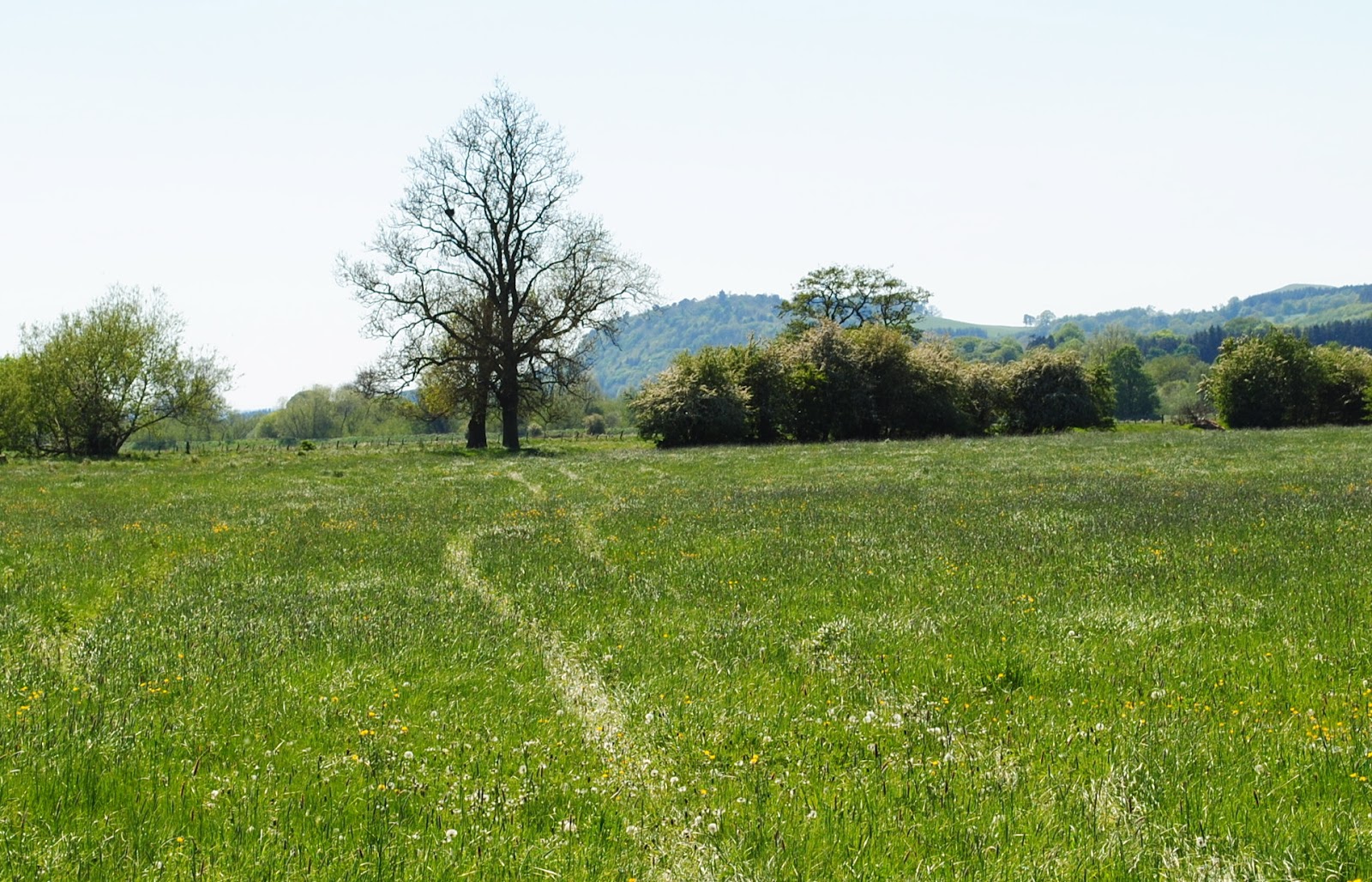
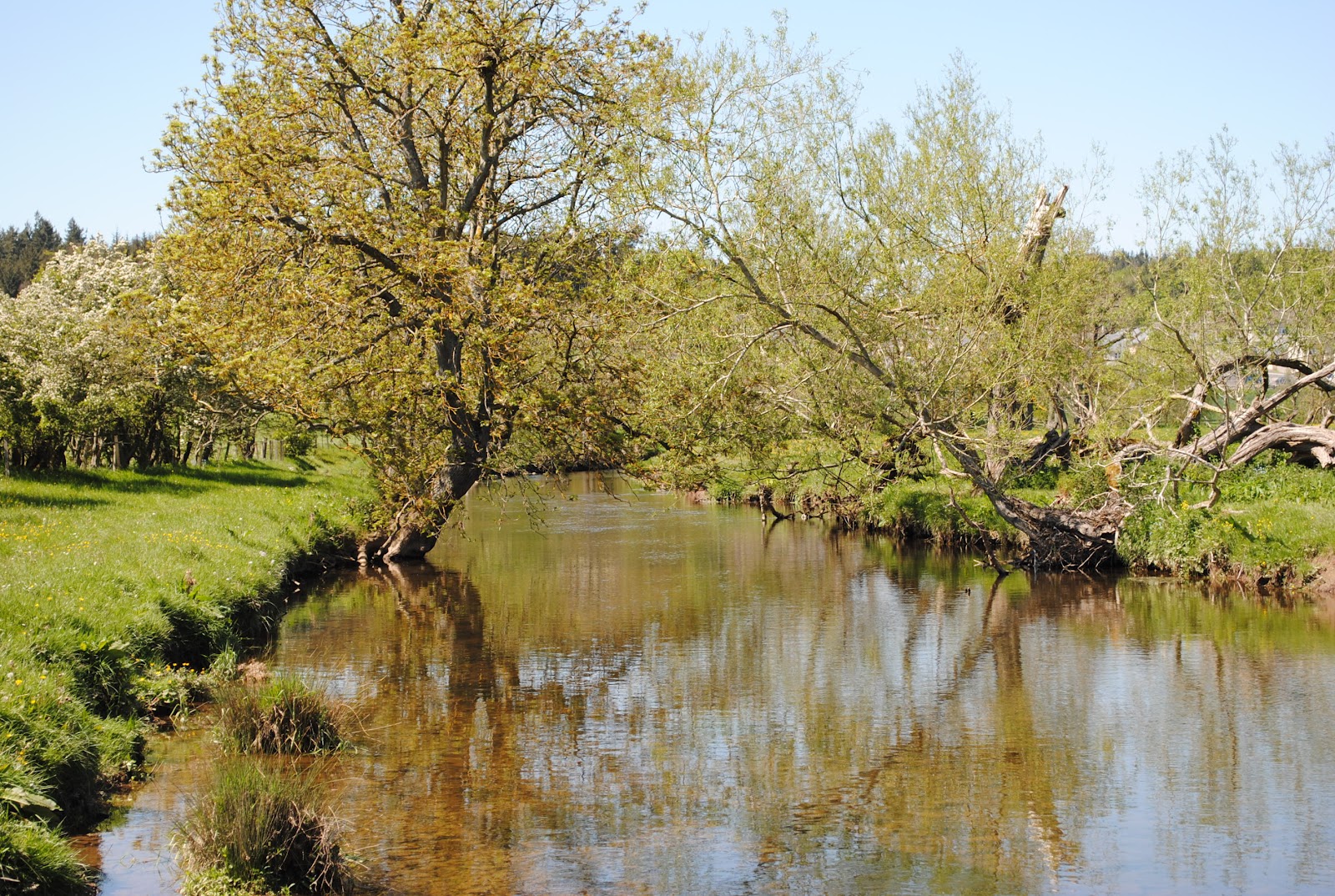
From Ancrum, the Ale winds its way through fields and trees and I'd forgotten how beautiful it all was and what fantastic vistas you get of bonny Teviotdale. The first thing you notice is Rubers Law, the conical mountain that dominates the southwest skyline, birdsong fills the air, goldfinches, chaffinches, swallows and blackbirds, and hundreds of swooping sandmartins that nest in the sandy scaurs above the river.
The village green and the war memorial
As you make your way through the fields and over meadows filled with wild flowers the river straightens for the final length of its journey to merge with the more powerful Teviot. A few moments reflection and you realise you are surrounded by history. On a slope overlooking the far bank of the larger stream, you can understand how Timpendean Tower which I visited in a previous blog, must have dominated this key river route. In the far distance another tower looms down from Minto Crags a few miles west; quaintly named Fatlips castle is a sixteenth century peel tower built by the Turnbull clan, and which is now being restored to its former glory.
I once caught a salmon here, but probably shouldn't

And on a hill to the east, yet another monument, the most spectacular of them all. 
At first glance you could mistake what the locals call Penielheugh (pronounced py-nel-hyu) for a NASA rocket. It stands 150 feet tall and dominates the landscape for miles around. It is actually the Waterloo Monument, built for the Marquess of Lothian between 1817 and 1824 to commemorate the great victory over Napoleon. It stands on the site of an Iron Age fort and when I was young you used to be able to climb to the top, but elfn'safety has put a stop to that nonsense.

Looking east towards the Waterloo Monument
 From the top of the tower you could see across the Teviot Valley to Bonjedward and Monklaw, and it's said that the then Marquess (who may have been a bit mad, unlike the present charming incumbent) planted groups of trees to represent the relative positions of the allied and French troops, and that Penielheugh is where the Iron Duke would have conducted his battle from.
The picture of Penielheugh with wild flowers in the foreground is my favourite photo of the day. It reminds me that there's only one place you ever really call home.


For reasons that are beyond my technical know-how the typesetting on this blog is not what it should be, but I hope the spirit remains true.

Thursday, 24 May 2012

The Isis Covenant unveiled

I just thought I'd give you a flavour of my new book The Isis Covenant (published as James Douglas) which is out In August.

'The Crown of Isis, once part of the treasure of Queen Dido of Carthage, was reputed to grant its wearer immortality. In AD64 it was stolen from the Temple of Isis. It was believed lost forever. Until now. Art recovery expert Jamie Saintclair receives an unexpected phone call from Brooklyn detective Danny Fisher. Two families have been brutally murdered, one in New York, the other in London. The only link is a shared name, that of a German art thief who disappeared at the end of the war. Jamie’s investigation will take them into the dark past of Nazi Germany, to a hidden world of the occult – where a carefully guarded secret reveals a legacy of bloodshed. As Jamie and Danny will discover, for the promise of eternal life there are those who would kill, and kill again.'

The book cuts between a ruthless expedition in Roman Africa, the last hours around Hitler's bunker during the fall of Berlin in 1945, and a desperate contemporary life or death race against time to discover the truth behind a terrible secret.

Monday, 21 May 2012

Thought for the day

Apologies for the short absence. Normal service will be resumed once I've got my character up this mountain and made up my mind what happens when he gets to the top. Doug

Monday, 30 April 2012

A taste for blood

A couple of weeks ago I uploaded a few hundred words from one of the crime books I have on the stocks waiting to be published. It got a lot of good reaction and more page views than any other blog I've written.

So it seemed a good idea to give the world a taste of book two.

This is the prologue of War Games, but the main action takes place in and around my old stamping ground in the Borders and features my hero, a Falklands War veteran with a guilty secret and an unlikely talent. A girl has gone missing, but has she been kidnapped, as her industrialist father claims, or has she run away from an arranged marriage as her friends believe? When the police give up the hunt Assad Ali calls in the last resort after all the other last resorts have run out: a psychic investigator. But as the investigation develops Gurya Ali isn't the only teenager who's vanished. And when they start turning up dead it becomes clear he's in a race against time with a serial killer - a serial killer with a liking for gruesome trophies and an obsession with a Medieval hero.

Let me know what you think

War Games
Prologue

Jose Caracol was the first, but I wouldn’t find that out until much later. Jose was a street-savvy, sixteen-year-old Spaniard, but he was part-Tunisian, part-Gitano, which made him a one hundred per cent outsider. In the summer, he scraped a living fleecing the tourists who throng the concrete-canyoned resorts around Malaga, but in season he walked the dusty roads along the Guadalteba River looking for work as an olive picker to raise money for his much-extended and entirely undeserving gypsy family. No-one was able to figure out why he should be in the heat-scorched Andalucian hill village of Teba that Friday, August 25, when thousands of red-nosed guiris were asking to be shorn of their euros forty miles away down on the coast.
Not many guiris make it as far as Teba, because it’s a long and dusty drive on bad roads, through alternating rocky outcrops where only the buzzards and the vultures soar, and dull, characterless hillsides lined with regimented ranks of olive trees. The main reason tourists make the effort is to visit the Castillo de la Estrella - the Castle of the Stars – the ruin which has dominated Teba and its people since the Romans came to Spain more than two thousand years ago.
Local legend says that from the castle tower you could reach up and touch the heavens, but now you make the climb to look down on the village, which shines like a silver jewel on a plain of sun-baked red earth that stretches away towards the distant hills of the Sierra Ronda. Teba is pretty enough, in the white-walled, red-tiled Andalucian fashion. Its narrow streets will lead you to a couple of fine churches and a quiet village square. A mile to the south is the garganta – a precipitous gorge which attracts butterfly collectors and bird-spotters. And that’s about it. It’s not really a very interesting place to die in. Or to die for.  
 But looks can be deceptive. Seven hundred years ago that innocent plain below the castle echoed to the thunder of a thousand charging war horses. Men fought and cursed and died, and their blood stained the red earth of the plain redder still. The battle they fought has never really ended. Jose Caracol was one of its casualties. But, of course, he never knew that.
A farmer discovered the body close by a dirt roadway, in one of the narrow, rush-filled ditches that split the plain. Prudently, he decided to leave Jose just where he was. By the time the local police summoned their national counterparts up from Malaga the August sun had turned the corpse almost black. Still, it wasn’t difficult to work out how he’d died. Lieutenant Alvares, in charge of the investigation, studied the intensive pattern of knife wounds concentrated around the victim’s face, neck and chest, and wrote the word ‘frenzied’ in his black notebook. His interest was drawn to a particularly large gash in the left breast and his moustache twitched with distaste as he recognised the reason for it. ‘Cabrons,’ he muttered.
 A search of the dead boy’s clothing had already placed Jose’s identity card in his hand. When he studied the bony, dark-skinned face with its barely concealed sneer it was difficult to keep his interest from waning. He knew what he would find when he typed the name into the Malaga police computer system. A dozen – maybe many dozens – of arrests for theft and other petty crimes, a few short stays in youth prison. His view was confirmed when he questioned the shopkeepers and the villagers of Teba. Sure, we get gypsies around here. They’re pests – no-one actually used the word vermin, but it was there just the same - to be watched like the stray dogs that wait to steal from your kitchen. No, nobody remembered this particular gypsy.   
Lieutenant Alvares decided to stay overnight in Teba, for form’s sake. He – politely – asked his counterpart in the local police to identify any groups of gitanos in the surrounding area. Relationships between the two forces had to be conducted like the first tentative steps of the flamenco dancer; one at a time, and always with delicacy. He would question the gypsies the next morning, with the local officer at his side. The thought of the blank, uncooperative faces gave him a slight feeling of indigestion. He tried very hard to fight it, but in his mind he had already filed Jose Caracol as the victim of a turf war between two rival gitano clans. The only thing that disturbed this certainty was the mutilation done to the body. It seemed very – deliberate, yes that was the word – deliberate, compared to the savage nature of rest of the attack. It raised certain doubts that would stay with him for many weeks. But, no, these people, they were without morals, without conscience. He studied the thing the dead boy had clutched in his hand. Who was to know what messages they sent to each other in their crude un-Spanish way? Still, he would do his best to discover the killers. The location and the date didn’t strike him as significant, unless that it was, for Jose Caracol, the wrong place at the wrong time. He was right, but not in the way he thought. But he wouldn’t find that out until much later.